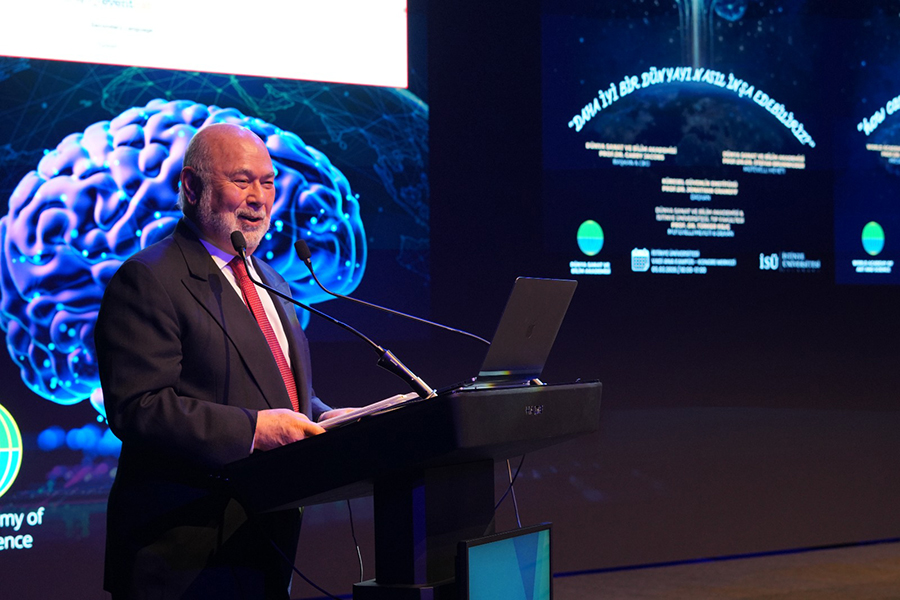

On October 23, 2025, Global Security Institute Advisory Board Member, the Hon. Douglas Roche O.C., received an award from the Canadian Leadership for Nuclear Disarmament (CLND) for Distinguished Achievement in Nuclear Disarmament. It was followed by a lecture given by Mr. Roche titled Creative Dissent: A Politician’s Struggle for Peace:
“Amazingly, I’m still here. Good times and bad times, I’ve seen them all in my years, and I’m here. The first prime minister I remember was Mackenzie King, whom I used to see walking his dog when I was a boy growing up in the Sandy Hill area of Ottawa in the late 1930s. I was 16 when the atomic bombs were used against Hiroshima and Nagasaki. I remember Gandhi, Churchill and JFK. I was first elected to Parliament a few days before Lester Pearson died and sat in the House of Commons a few rows behind John Diefenbaker. I’ve been through Trudeau, twice. Joe Clark, Brian Mulroney and Jean Chrétien all deeply affected the course of my life. I’m not much attached to politics these days, but I’m here. Perhaps I’m still hanging around because I love this beautiful and troubled planet so much and am not in a particular hurry to leave it.
You see, one day many years ago, I made a great discovery. As a young journalist in the 1960s, I travelled through emerging Africa, Latin America, and Asia, and wrote the life stories of an Ibo teacher in Nigeria, a Communist labour leader in Venezuela and a farmer in Kerala, India. Suddenly, one day, I realized that most of the world was non-white, non-Western, and non-Christian, and that I was in a distinct minority in the world. The bold thought entered my mind: maybe we’d better all get along.
Years later, when I started going to the United Nations — an institution I revere and proclaim to the rooftops as the indispensable instrument for peace in the world and deeply lament how shabbily the major powers treat it — I could see, on a crowded day in the General Assembly, the faces of the modern world: non-white, non-western, and non-Christian. And that, yes, since many of the U.N. meetings I have participated in for half a century revolved around the fate of nuclear weapons, we’d better get along.
I didn’t think about nuclear weapons when I was first elected to Parliament. In fact, my mind was on the development process. I went to Bangladesh to do a study on the effects of Canadian aid projects and there I met a mother named Kumu and, though I only spent an hour or so with her, she changed my way of understanding the modern human condition.
Since I was accompanied by a Catholic Sister, Kumu invited me into her village home, a simple hut made of a mixture of clay and mud with grass for a roof. There was no electricity. The nearest source of clean water was several hundred metres away. The cooking seemed to be done over small outdoor fires. Kumu and I sat on plain wooden chairs, her eight children gathered around her. There was enough food at the present time, she said, although the children’s faces and bellies clearly revealed nutritional deficiencies. The date palm juice that flows from trees like maple sap was very good for them, Kumu said, pointing to the fire outside where a pot of juice was being heated.
After a while, I left, circling through the compound and talking to some of the elders sitting in the sun. As I started down the trail leading out of the village, Kumu came running after me, carrying a pitcher. She wanted me to have a glass of the warm palm date juice, which she had been heating for me while we talked. Suddenly, it dawned on me that, through the date juice, which was all she had to offer, this woman was extending her friendship to a strange white Westerner who had dropped into her life for a moment. I knew it was a memory I would treasure and learn from.
The statistics on poverty, to be fully understood, need a human face. So too the statistics on nuclear weapons. What does it really mean to recite that nine states today possess 12,240 nuclear weapons, each many times more powerful than the atomic bombs that killed an estimated 210,000 people in Hiroshima and Nagasaki? My travels in the 1970s took me to both Japanese cities and there, in the museums, I saw photos of entire blocks completely obliterated, the charred clothing and the depictions of survivors, their burnt skin hanging from their arms and heads. I talked to some hibakushas (people affected by the atomic bombings in 1945) and was stunned to learn from personal testimony the great wrong that had been done to them. I started writing and speaking about the horrors of nuclear weapons.
I returned to Hiroshima and Nagasaki several times over the years, each time deepening my commitment to the abolition of these instruments of pure evil. My friend Mayor Tad Akiba made me an Honourary Citizen of Hiroshima. At the ceremony, I shared a platform with Keijiro Matsushima, who told the audience about his experience of the attack when he was 16. “There was an orange and yellow flash followed by a huge explosion and an intense heat wave,” he said. “There was blood all over me. I thought I was going to die.” Had he been on the other side of the room, where the ceiling collapsed on students, he would have. When Matsushima finished speaking, I said to the audience, “He is my brother. I, too, was 16 when the bomb exploded. He has suffered enormously. Now I must help him to ensure that this never happens again.”
The two themes of development and disarmament have driven my political thinking since my early days as a parliamentarian. I became preoccupied with a central fact of modern life: we were entering a totally new period of our planet’s history. For the first time, the opportunity existed to bring about a better life with larger freedom for the world’s people, but never was the world so hungry and the threat of war more monstrous. Yet we went on, seeking our self-interest, oblivious to the depths of the danger or the magnificence of the challenge. I found the words of the poet T.S. Eliot stunningly accurate: “Here were decent godless people. Their only monument the asphalt road. And a thousand lost golf balls.”
I found parliamentary life in Ottawa not to be very conducive to the expression of such thoughts. Then one day in 1980, I received an invitation that was to shift the focus of my entire public career. The Canadian Association of the Club of Rome, a global think tank, invited me to give a paper, “Development in the Year 2000.” I felt challenged. How did I know what would happen so far in the future? I decided to take a couple of months to research the subject as best I could. The more I poured over statistics and reports, the more I found the world painfully off balance: opulently rich in the forces of death, yet poor in providing for the needs of human lives. I found this social deficit a threat to world security because the festering problems, neglected in favour of armed might, promised rising public anger and social upheaval. I wrote that we would not find order in the post-2000 era if governments continued to divert money needed for human development to the accumulation of more arms. In short, development demands disarmament.
The relationship between development and disarmament came to a head in 1987 when the U.N. held an international conference on this very subject. By this time, I was Ambassador for Disarmament and chaired the Canadian delegation. The conference chairman was Ambassador Muchkund Dubey of India and we became good friends. Personally, I supported his proposal for a fund to be set up for a portion of the funds released through disarmament measures to be transferred to development in the name of greater security for all.
But this idea was considered too radical by the Western countries, and the most they would settle for was a final statement legitimizing the relationship between disarmament and development. So, at least the final document achieved a consensus that disarmament and development are two of the most urgent challenges facing the world and also are the two pillars on which enduring international peace and security can be built.
The final document was a breakthrough at that time because it said: “Security consists of not only military but also political, economic, social, humanitarian and human rights and ecological security.” That is the very definition of common security, and my hopes soared when, after the fall of the Berlin Wall and the end of the Cold War, the Security Council met at the summit level for the first time and used that precise language in its communique. I rejoiced that the world was coming to a new understanding of what security was all about. Security could not be obtained by large numbers of arms: rather it could only come about by attention to meeting human needs.
This theme of common security became, and stayed, the central tenet of my political life even though the major governments cast cooperation aside in the post- 9/11 world. The 1990s presented a golden moment to solidify a peace dividend for the world. But it never happened. NATO began its fateful expansion. The military-industrial complex, which President Eisenhower had first warned about, increased its dominance of American politics. Global military spending has increased every year for the past decade and in 2024 exceeded $2.7 trillion.
Think about the contradiction the political order is foisting on us. The total amount of money countries annually spend on arms is now 750 times what they spend on the U.N. The NATO countries are planning to spend five percent of their GDP on defence while the U.N. is now cutting its budget and laying off staff. The arms trade thrives and people starve.
The world is now swirling around us. International humanitarian law is flouted as authoritarianism spreads. I am totally with U.N. Secretary-General António Guterres’s cry, “We have entered into an age of reckless disruption and relentless human suffering,” and, he adds, leaders must decide now “what kind of world we choose to build together.”
Much of my public career has been marked by dissent and I’m not stopping now. I dissent from the wild disproportion of what the world spends on arms and what it spends on development. I dissent from the anti-humanitarian policies of war for peace. I dissent from the perpetuation of poverty through the greed of the rich. I dissent from the despoliation of the planet by short-sighted industrialism. Most of all, I dissent from the fabric of lies spun by the proponents of nuclear weapons who would have us believe that these heinous instruments of mass murder make us safer.
Soon there will be no more living hibakusha. Who will carry forward their message that what happened in Hiroshima and Nagasaki must never happen again? We and our colleagues and the next generation must keep alive the conscience of the world protesting against such evil.
Already, the global conscience against nuclear weapons is weakening as arms control treaties break down and new nuclear arms races start up. Threats to use nuclear weapons are chilling reminders of how dangerous the world has become. We now envision future wars being run by artificial intelligence. And even our own Government of Canada, giving militarism a higher priority than diplomacy, has joined the Western pretence that a Golden Dome missile defence system will save us. We must stop making the same old mistakes as the world hurtles into a new era. The “wooden-headedness” of governments, as the historian Barbara Tuchman called it, must stop. Government must cease pretending that military might and bombing innocent civilians will bring us security.
Where shall we turn to to get our bearings? With John F. Kennedy, I believe we can find peace not through a revolution in human nature but the gradual evolution of the institutions we have already built. The Charter of the United Nations is an anchor for us. So too are the Universal Declaration of Human Rights and the Nuclear Non-Proliferation Treaty. These are more than documents. They are milestones in the human journey and we need to protect them no matter the vicious political storms attacking them.
They teach us that every human being has the sacred right to peace. In fact, on Dec. 19, 2016, the U.N. General Assembly adopted the Declaration on the Right to Peace by a vote of 131 states in favour, 14 opposed and 19 abstentions. The Western states led the opposition. The opponents fear that formalization of the right to peace will pave the way for a future comprehensive law against warfare. That is exactly the point. As humanity continues to mature with each new generation, we must aim for a world without war. As our understanding of the universality of human rights grows, we will come to understand that the existence of weapons of mass destruction is absolutely incompatible with every human being’s right to live in peace.
Though we cannot — at least not yet in the moving history of the world — implement the right to peace, we can practice a culture of peace. A culture of peace revolves around non-violence, sustainable development, respect for all human rights, education, and the development of a strong public opinion. Our goal must be nothing less than the mobilization of a strong public opinion to move governments to a common security agenda. Never doubt that this can be done.
I turn to the next generation to keep alive the dream of a nuclear weapons free world as the basis of common security. At first, the idea of the abolition of slavery was just a dream, but it happened. So did the dream of freedom from colonialism. And the dream of ending apartheid. All these evils were ended because enough people rose up and demanded governments end them. Aim high. Set the year 2045, the 100th anniversary of the bombing of Hiroshima and Nagasaki and also the 100th anniversary of the signing of the Charter of the United Nations as the year that the peoples of the world will be free of the spectre of nuclear weapons.
We can obtain a world that is human-centred and genuinely democratic, a world that builds and protects peace, equality, justice and development. We can obtain a world in which human security, as envisioned in the principles of the U.N. Charter, replaces armaments, violent conflict and wars. We can obtain a world in which everyone lives in a clean environment with a fair distribution of the earth’s resources, and international law protects human rights.
The politics of the past have brought us untold wars and suffering, Isn’t it time to try something better? Isn’t it time to bring our heads and hearts together to produce true human security? Isn’t it time to raise the standards of civilization for the sake of survival? Spare me the charge that this is mere idealism. The agenda for survival is no longer a dream but a pragmatic demand of the human race.
I have found that, for me, personal creativity is the best way to overcome political intransigence — especially today as we stumble through a dark valley on the long human journey from a culture of war to a culture of peace. Dissent can become creative when we care enough about failed public policies to do something to move forward. The organizations I have been involved with over many years have helped to strengthen the fabric of peace and they have strengthened me on the journey. Out of our griefs and anxieties, we build a new basis of hope.
I see hope as more than a blind assumption that things will turn out all right. Hope is best understood as a verb, connoting an active desire with the expectation of fulfillment; we long for something and will it, through our actions, to happen. That very process generates hope. It activates us in the search and provides a pathway from vision to reality.
I feel a strength within me. I feel it when I look at a map of the world and recall all the beautiful places I have seen through decades of travel. I feel it when I read the history of the world and see how far humanity has traveled. I feel it when I see the benefits of science, medicine and technology. I feel it when I see the face of an infant, knowing the challenges that lie ahead for the baby. I feel deeply about the development of this new human being — and all human beings — in a world at peace. That is why I do this work.
What I feel most is that the human journey cannot be stopped. We are, often in spite of ourselves, lifting up our civilization. An alliance of civilizations lies ahead — if we can avoid blowing up the earth. Though often in turmoil at the news of the day, I am at peace with the world, and I think I have found peace within myself. I could not stand here and lecture about peace or write books about it if I did not feel a certain peace within me. The words of Isaiah guide me: “Peace, peace to the far and near, says the Lord, and I will heal them.”
We live at a powerful moment. The movement from a culture of war towards a culture of peace is unquestionably one of the greatest human shifts of all time. We are part of this movement. It is a privilege to do this work. We are claiming the future. We are building a better world. This is the basis of hope. Hope is how we survive.”
These remarks were given as part of an event held on October 23, 2025 titled “Creative Dissent: A Politician’s Struggle for Peace”. The event was presented by Canadian Leadership for Nuclear Disarmament and the Centre for International Policy Studies. The remarks were given by Douglas Roche, the 2025 recipient of the Distinguished Achievement Award from Canadian Leadership for Nuclear Disarmament. The entire event is available on the CIPS Youtube channel.
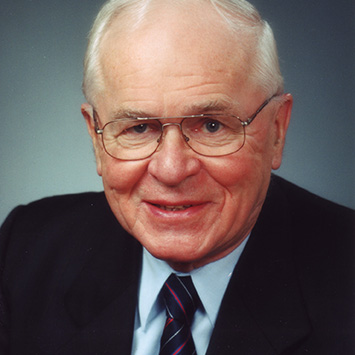
Former Senator, the Hon. Roche, O.C., is on the Board of Advisors of the Global Security Institute. He is an author, parliamentarian and diplomat, who has specialized throughout his 40-year public career in peace and human security issues. He lectures widely on peace and nuclear disarmament themes. Mr. Roche was a Senator, Member of Parliament, Canadian Ambassador for Disarmament, and Visiting Professor at the University of Alberta. He was elected Chairman of the United Nations Disarmament Committee at the 43rd General Assembly in 1988. His latest book is Keep Hope Alive: Essays for a War-free World (Amazon)