
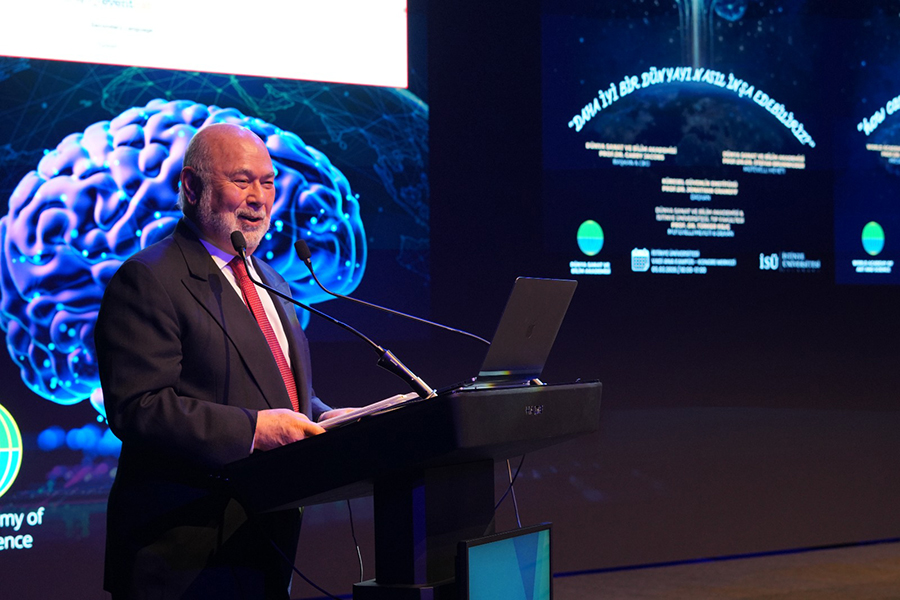
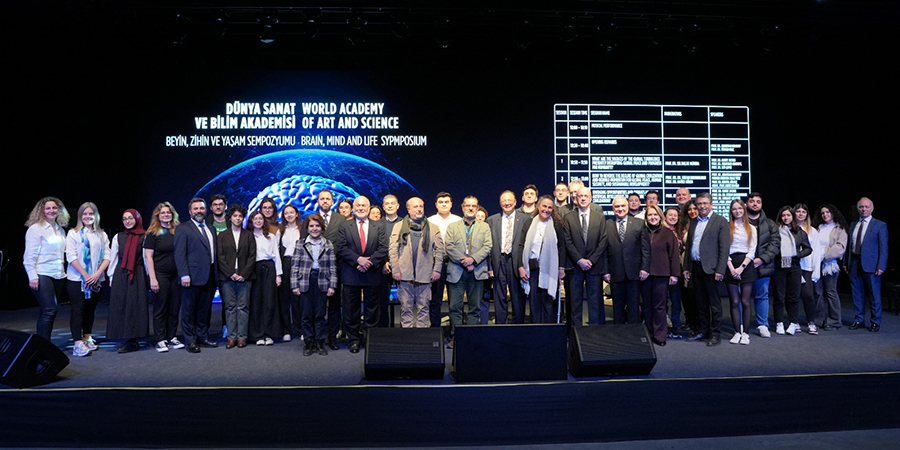
At Istinye University’s Brain, Mind, and Life Symposium on 5 March 2026, in Istanbul, a gathering of international thinkers set out to examine some of the most pressing questions of our time: how humanity navigates accelerating technological change, deepening global instability, and the search for a more coherent vision of the future.
The event was hosted by Instinye University and The World Academy of Art and Science, of which GSI President Jonathan Granoff is a Fellow and Trustee — who helped frame the day’s conversations while consistently bringing participants back to a shared ethical foundation.
Jonathan’s contribution established the tone of the symposium. In his opening remarks, he emphasized that the crises facing humanity—whether geopolitical conflict, environmental degradation, or the rapid rise of artificial intelligence—cannot be understood in isolation. Instead, they are deeply interconnected challenges that demand integrated solutions. His perspective resisted fragmentation, urging participants to recognize that peace, sustainability, technological development, and human dignity are all part of a single, interdependent system. This framing became a theme for the discussions that followed.
The symposium itself was structured around a series of sessions that addressed different dimensions of global transformation. Topics ranged from “global turbulence” and the erosion of international stability, to the need for new frameworks capable of guiding civilization in an era defined by complexity and uncertainty.
A defining feature of Jonathan’s approach was his insistence on ethical responsibility as the foundation for progress. In discussions about global instability, he highlighted the importance of strengthening institutions that promote cooperation and dialogue, rather than division. He underscored that lasting security cannot be achieved through force alone, but must be built on trust, mutual respect, and a commitment to shared values. This emphasis resonated strongly in a world where traditional geopolitical frameworks are increasingly strained.
Jonathan’s influence was particularly evident in the session focused on artificial intelligence, a topic that has rapidly moved from the margins of academic inquiry to the center of global concern. Serving as moderator, he ensured that the discussion did not become narrowly technical but instead addressed the broader implications of AI for society. The session explored how emerging technologies are reshaping not only economies and governance systems, but also the very nature of human identity and agency.
Rather than framing AI solely as a risk or a tool, Jonathan encouraged participants to consider it within a larger moral and philosophical context. What does it mean to create systems that can make decisions, influence behavior, or generate knowledge? How can humanity ensure that these systems serve the common good rather than exacerbate inequality or undermine democratic values? By posing these questions, he elevated the conversation beyond immediate concerns toward a deeper exploration of responsibility and purpose.
Jonathan consistently returned to the idea that humanity stands at a crossroads. The challenges being discussed—whether technological, environmental, or political—are not separate crises, but expressions of a broader transitional moment in human history. This perspective framed the symposium not as an abstract academic exercise, but as a call to action.
As participants explored alternative frameworks for organizing society—ones that might better align with ecological realities and human well-being—Jonathan emphasized the need for a values-based approach. Innovation, he argued, must be guided by principles that prioritize life, dignity, and the long-term health of the planet. Without such grounding, even the most advanced systems risk perpetuating the very problems they seek to solve.
In his closing remarks, Granoff helped synthesize the day’s discussions, drawing connections between the different sessions and reinforcing the urgency of collective action. He emphasized that the insights generated during the symposium must not remain confined to academic discourse, but should inform real-world decisions and policies. His message was both sobering and hopeful. While acknowledging the scale and complexity of the challenges ahead, he also pointed to humanity’s capacity for innovation, collaboration, and moral growth. The future, he suggested, is not predetermined, but shaped by the choices individuals and institutions make today.

The Global Security Institute is dedicated to strengthening international peace and security based on co-operation, diplomacy, shared interests, the rule of law and universal values. Our efforts are guided by the skills and commitment of our team of former heads of state, distinguished diplomats and politicians, celebrities, religious leaders, Nobel Peace Laureates, disarmament and legal experts, and concerned informed citizens. Our focus is on controlling and eliminating humanity’s greatest threat – nuclear weapons.


