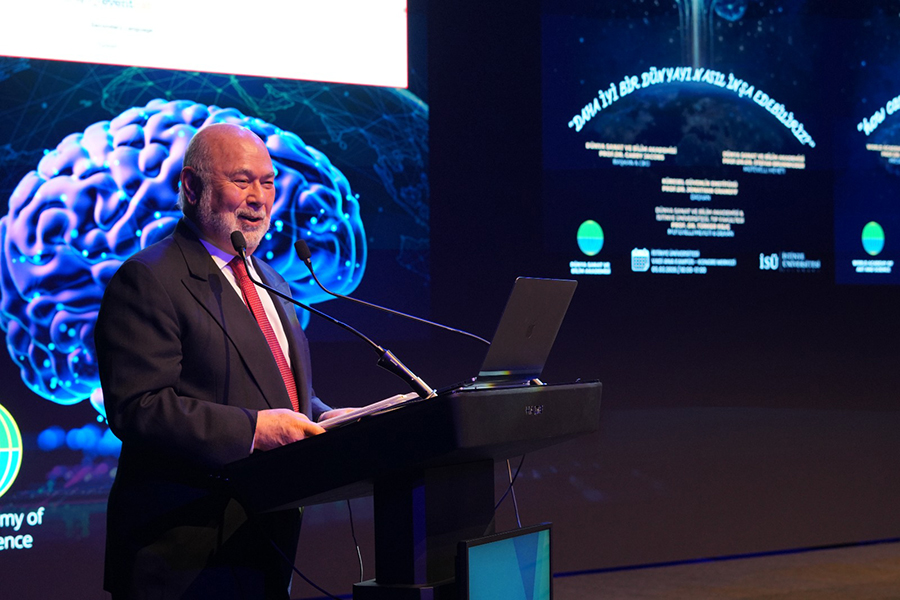

On 11 November 2025, the FW de Klerk Foundation, in collaboration with the Konrad-Adenauer-Stiftung, hosted the Fourth FW de Klerk Memorial Lecture, to commemorate President De Klerk’s legacy in Cape Town, South Africa.
The Foundation hosted Jonathan Granoff, President of the Global Security Institute, as the keynote speaker, who delivered a lecture on: “FW de Klerk’s Commitment to Justice: Transformation, Constitutionalism and the Abolition of Nuclear Weapons”.
In his lecture, Jonathan reflected on his many meetings with Mr De Klerk at World Summits of Nobel Peace Laureates, some of Mr De Klerk’s greatest achievements — such as initiating South Africa’s constitutional transformation, abolishing South Africa’s nuclear arsenal and making South Africa a leading member of the Nuclear Non-proliferation Treaty. He concluded his address by offering some suggestions as to how we can fulfil our intergenerational responsibilities and how change at one moment can seem impossible, until, by working together, it isn’t.
Watch the lecture highlight video / Watch the entire event / View the lecture gallery / Read the Foundation’s statement
Speech by Jonathan Granoff: “Let me express my gratitude to the FW de Klerk Foundation and its leadership for bestowing on me the privilege to honour the legacy of one of modern times most distinguished heroes, President FW de Klerk.
He seized an historic opportunity of a convergence of moral imperatives and practical necessities to end the racial injustice and suffering arising from apartheid and the hazard of the possession and implied threat of use of a nuclear arsenal.
I had the opportunity to work personally with President De Klerk, and his close friend and former leader of this Foundation, Ambassador David Steward, at over a dozen summits of Nobel Peace Laureates and observed first hand his even handed leadership, capacity to listen and incorporate the concerns of others, ability to achieve consensus where others would have thrown their hands in the air, and act decisively with impeccable timing to achieve success. I would like to begin by only commenting on what he achieved and what he has left us that is of value today:
A vision that is noble and practical for this and any nation that sets a compass of how to proceed to stability and abundance. Here are his words of his vision for South Africa expressed in his Nobel Peace Prize acceptance speech:
It insures the full participation in all fields of endeavour to all South Africans. It does not discriminate in any way on the basis of colour, creed, class or gender.


It contains all the major safeguards which all our communities will need to maintain their respective identities and ways of life. It also provides adequate guarantee for the political, social, cultural and economic rights of individuals.
I also believe that this framework for peace will succeed if we can now establish the frame of mind, which is necessary for peace – the frame of mind which leads people to resolve differences through negotiation, compromise and agreements, instead of through compulsion and violence.
If one looks at the existing South African Constitution it actually includes the elements of this vision.
But there is a deeper inner vision not often associated with De Klerk and which should not be overlooked for it is instructive to all of us. It tells us of the frame of mind and heart we need most:
The greatest peace, I believe, is the peace which we derive from our faith in God Almighty; from certainty about our relationship with our Creator. Crises might beset us, battles might rage about us – but if we have faith and the certainty it brings, we will enjoy peace – the peace that surpasses all understanding.
There are two axioms of instruction relevant to this insight:
Love God with all of one’s soul, heart and mind, and like this to love our neighbour as we love ourselves.
The first part is the inner part, the second part includes skilful means of attaining the aspiration of the highest ideal of love.
The means of governance and the institutionalisation of justice is basic to attaining the peace with our neighbours, whether at a local or a national or international level. One of the greatest threats to that peace that concerned President De Klerk was nuclear weapons:
He said at a conference in Helsinki in 2013:
At this very moment, gliding noiselessly beneath the surface of distant oceans there are nuclear submarines armed with destructive power that would make the cataclysm of Hiroshima seem relatively insignificant. A single Trident submarine reportedly has the capacity to launch up to 192 independently targeted warheads in the 450 kiloton range at as many cities within a range of 6 000 kms. Each warhead has a destructive power twenty-five times as great as the bomb that destroyed Hiroshima. The United States has 14 Ohio class submarines armed with trident missiles. The Russians, British, French and Chinese similar – but fewer, such nuclear armed vessels.
The qualitative and quantitative threat he described then has only increased with the current geo political instabilities. His solution is worth noting for he walked his talk.


Responding to the build up of Soviet supported forces, particularly Cuban forces in Angola, in the 1970’s, South Africa developed a nuclear weapons program and produced six nuclear weapons capable of immense destruction. The theory of this strategy was that if there was an immanent regional threat South Africa would reveal its nuclear capacity in the belief that this would stimulate United States engagement of support to ensure that the nuclear weapons would not be used.
The end of the Cold War, the fall of the Berlin Wall, and the removal of 50,000 Cuban troops from the region led FW de Klerk to analyse the morality and logic of nuclear weapons possession and implied threat of use. He concluded that elimination of the arsenal was the prudent and morally correct action. In early 1990 this was done under his leadership.
This led to South Africa becoming a leading member of the Nuclear Nonproliferation Treaty (NPT), the third most important legal instrument of the 20th Century, after the UN Charter and the Universal Declaration of Human Rights. The Treaty promises the right to peaceful uses of nuclear energy, the good faith negotiations by the five nuclear weapons states (US, UK, China, Russia and France) to achieve nuclear disarmament and the renouncing of the possession of nuclear weapons by all, but four nations of the world – India, Pakistan, Israel and North Korea.
The nation of South Africa is an influential leader in the demands for nuclear disarmament in the negotiations and regular review processes of the NPT. Further it was a leader in the Treaty on the Prohibition of Nuclear Weapons, which bans possession of the weapons and now has over 90 State signatories and, significantly, helped create a nuclear weapons free zone in Africa through the Treaty of Pelindaba. The leadership in the international campaign to abolish nuclear weapons of South Africa rests on its moral decision to eliminate its arsenal.
FW de Klerk’s vision extended into the future. As he said:
We owe it to the children of the world to stop the conflicts and to create new horizons for them. They deserve peace and decent opportunities in life. I should like to dedicate this address (his Nobel acceptance speech) to them and to all those – such as UNICEF – who are working to alleviate their plight.
The question that we must ask is whether we are making progress toward the goal of universal peace. Or are we caught up on a treadmill of history, turning forever on the axle of mindless aggression and self-destruction?
I would like to end with two suggestions to help fulfil our intergenerational responsibilities.
Every secondary school child should have a copy, electronically shared or physically, of the Universal Declaration of human rights. Every person needs to know their national civic duties as well, in today’s world, of our global duties, all resting on the respect of the inherent dignity and rights of every person.
Because the Golden Rule is the basis of ethics in every world religion and resonates with the conscience it guides us as a goal to be sought, whether attained in full or not.
Either restraining ourselves from harming others we would not want to be harmed or treating others as we wish to be treated. When stated by Jesus, Mohammed, Mahavir, Confucius or any other wise person until this day and age, we could not melt the polar ice cap, destroy the health of the oceans, or kill humanity in an afternoon with nuclear weapons. Thus a Golden Rule for today is of value, for today our actions, as never before stretch into the future. We could benefit from aspiring to a Golden Rule for the 21st Century, Treat the lives and well being of future generations as we wish to be treated.
As Nelson Mandela and FW de Klerk worked together to do what seemed impossible, until it wasn’t, we can work toward what appears impossible but what is also morally demanding of us and practically necessary. Pursue justice in our governing and eliminate the evils we have produced. We honor by our actions the wise and virtuous who have gone before us. Thank you.”

The Global Security Institute is dedicated to strengthening international peace and security based on co-operation, diplomacy, shared interests, the rule of law and universal values. Our efforts are guided by the skills and commitment of our team of former heads of state, distinguished diplomats and politicians, celebrities, religious leaders, Nobel Peace Laureates, disarmament and legal experts, and concerned informed citizens. Our focus is on controlling and eliminating humanity’s greatest threat – nuclear weapons.